In many U.S. states, you can sell naturally shed deer and elk antlers if they were legally acquired. But there is no one-size-fits-all national rule. Collection seasons, public-land restrictions, species, residency, permits, commercial buying rules and transportation requirements can change the answer. Check the law where the antler came from and any rules governing the proposed sale or shipment before offering it to a buyer.
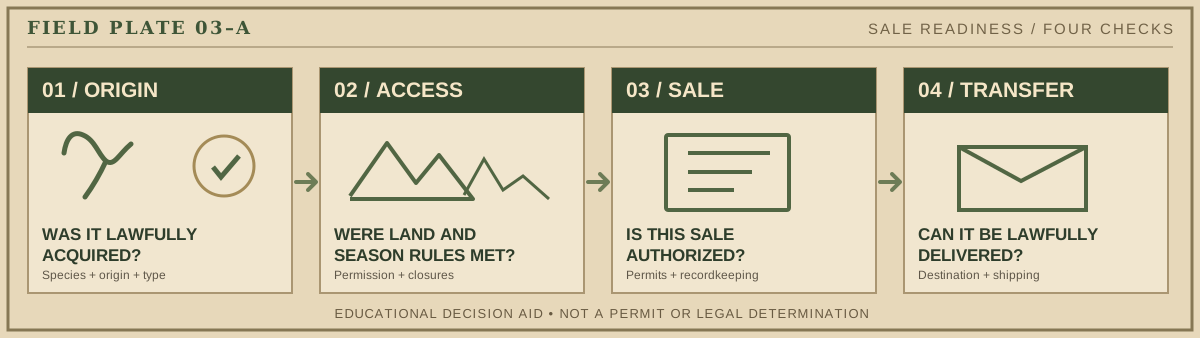
01 / Collecting Antlers and Selling Antlers Are Different Questions
Finding a shed in the woods does not automatically give you the right to take it home, and permission to possess an item does not necessarily authorize every sale. Each step can have separate requirements. Some states regulate when people may gather sheds to protect wintering wildlife. Others specify what wildlife parts may be sold, or regulate businesses that purchase antlers for resale.
| Stage | Question to answer |
|---|---|
| Find / collect | Was collecting allowed on that land, at that time, by that person? |
| Possess | Is the species and type of antler lawfully possessed, and is documentation required? |
| Offer / sell | May this item be sold? Do special commercial or recordkeeping rules apply? |
| Deliver / ship | Are transport and destination requirements met? Is it a domestic or international transfer? |
Example: Colorado allows certain legally acquired antlers to be sold, but has a separate annual closure on collecting sheds on public land west of Interstate 25 from January 1 through April 30. Permission to sell doesn't make collection during that closure lawful. Colorado Parks and Wildlife: collection rules.
02 / State-by-State Shed Antler Rules: Five Western Examples
These states are especially relevant to Western deer and elk shed hunters. The descriptions below are starting points, not blanket legal approvals. They distinguish the general sale rule from separate gathering, residency and documentation issues. If your state isn't listed, begin with its fish and game or wildlife agency.
| State | Sale or trade | Collection / other requirements |
|---|---|---|
| IDAHO | State law expressly allows possession or sale of naturally shed antlers or horns from listed species. | Nonresidents collecting, possessing or transporting specified Idaho-origin sheds need a qualifying Idaho hunting license, subject to an exception for certain children. Check local closures. |
| WYOMING | Do not infer an unrestricted sale rule from the collection regulation; confirm a proposed sale or shipment with Wyoming Game and Fish. | Designated collection areas have seasonal rules and resident/nonresident opening dates. Skull-attached finds require separate agency attention. |
| UTAH | Legally obtained shed antlers may be bought or sold at any time. Commercial antler buyers purchasing for resale need a Certificate of Registration. | Gathering January 1–May 31 requires an annual antler-gathering certificate. Emergency closures and transaction-record rules may apply. |
| COLORADO | State regulation permits trade in legally taken or acquired nonedible wildlife parts, including antlers, subject to exceptions. | Collection from public land west of I-25 is closed January 1–April 30 each year, with other rules and exceptions to check. |
| MONTANA | Statute expressly exempts sale, purchase or exchange of naturally shed antlers; a narrow natural-death skull-attached exception also exists. | Certain seasonally closed Wildlife Management Areas have a seven-day resident-priority period for antler gathering. Check access and collection rules. |
Official sources: Idaho Code §36-501 and Idaho Fish and Game; Wyoming Game and Fish; Utah DWR and Utah Rule R657-5-20; Colorado CPW and Colorado Ch. 0, §018; Montana Code §87-6-206.
Idaho
Idaho Code §36-501 permits the sale of naturally shed antlers or horns of deer, elk, moose, antelope and mountain goat and contains separate language for those species when the animals died naturally. Idaho Fish and Game explains that, since July 1, 2024, nonresidents generally need an Idaho hunting license valid for big game to search for, collect, possess or transport sheds originating in Idaho from deer, elk, moose or pronghorn. There is an exception for nonresidents younger than 12 accompanied as specified by the agency. Verify your situation and current closures rather than treating a general sale exception as permission to collect everywhere.
Wyoming
Wyoming restricts collecting in designated areas to protect wintering herds, including separate resident and nonresident openings. Its 2026 opening in Collection Area 1 was May 1 for residents and May 8 for nonresidents. Those dates describe the 2026 collection season, not an automatic rule for every location or future year. Wyoming Game and Fish also requires special authorization for antlers found still attached to a head or skull plate. Because collection rules alone do not settle every selling question, ask the department about the exact item and proposed transaction.
Utah
Utah allows sale of legally obtained sheds, but businesses or individuals who buy antlers to resell for financial gain need a Certificate of Registration. That is distinct from a person selling sheds they personally gathered. Utah requires a free, annually renewed antler-gathering certificate while collecting between January 1 and May 31. Rule R657-5-20 also contains antler transaction-record requirements; ask the DWR how these apply to naturally shed items where no animal was harvested, rather than leaving required fields blank on an official record.
Colorado
Colorado's general sale regulation permits trade in legally acquired nonedible wildlife parts including antlers, subject to other federal and state restrictions, and excludes certain categories such as velvet antlers in specified circumstances. The public-land collection closure west of I-25 remains a separate issue. Ask Colorado Parks and Wildlife about unusual species, skulls, or items of uncertain origin.
Montana
Montana Code §87-6-206 allows sale or exchange of naturally shed antlers and also a specifically worded exception involving antlers with skull portions attached from animals that died naturally and were not unlawfully killed, taken or accidentally killed. That exception does not mean every found skull may automatically be taken home or sold. For example, Montana wildlife areas with seasonal closures may limit when nonresidents can collect sheds after opening. Check the land-management rules and any possession requirements before taking skull-attached remains.
03 / Public Land, Private Land and Protected Areas
Private property: Permission from the landowner matters. Permission to enter land is not necessarily permission to collect and sell wildlife parts, and state wildlife regulations can still apply.
BLM and national forest lands: These lands are not automatically open for antler collection at all times. State rules, emergency winter-range closures, designated restrictions and any applicable limits on commercial activity can affect collection. Check the responsible local land office and wildlife agency.
National park units: Do not assume collecting is allowed. The National Park Service prohibits removing antlers in many parks and monuments; Yellowstone and Rocky Mountain National Park are well-known examples. Specific subsistence or park-unit exceptions may exist, so check the actual unit's rules. NPS: collecting antlers in Rocky Mountain National Park is illegal.
Check land ownership and current closures before going out. A public trail, national forest, wildlife management area and national park can each have very different rules.
04 / Natural Sheds, Harvested Antlers, Deadheads and Roadkill
A naturally shed antler normally separates from the skull at its base. That is not the same legal category as antlers attached to a skull plate or animal carcass. In many jurisdictions, found skulls—often called deadheads—require reporting, tagging or permission before removal. Lawfully harvested trophies and roadkill salvage may have still other paperwork.
Often treated differently from skull-attached antlers. Verify legal place, season and origin.
Keep harvest, tag, transfer and sale restrictions distinct from shed-antler rules.
Do not assume it can be removed or sold. Seek agency direction; evidence of poaching may be present.
Check the jurisdiction's salvage permits, reporting and possession rules.
Utah example: Utah DWR instructs people who find a deadhead not to move it and to report the find for agency review. Wyoming example: Wyoming Game and Fish advises people to obtain approval and an Interstate Game Tag for authorized skull-attached finds. Utah DWR • Wyoming Game and Fish.
05 / Does a Seller or Antler Buyer Need a License?
A person selling sheds they lawfully found is not necessarily regulated in the same way as a business buying sheds to resell. Utah makes this difference explicit: a commercial buyer needs a Certificate of Registration, while a person gathering their own sheds and selling them to a buyer does not need that particular commercial-buyer registration merely for doing so. Ordinary business registration, sales tax and marketplace rules are additional questions not resolved by wildlife law.
If you operate a bulk-buying business, sell antler crafts made from bought antlers, or purchase sheds for resale, verify the rules in the states where you purchase and operate. Don't assume a requirement in one state applies nationwide.
06 / Can You Ship Shed Antlers Across State Lines?
Many lawful shed-antler sales involve a buyer in another state. But a shipping carrier's willingness to accept a parcel is not a legal determination. Check the item's legal origin, any export/transport requirements, and applicable laws at the destination. Special rules may apply to skulls, certain species, and international orders.
The federal Lacey Act can make interstate commerce in wildlife products unlawful when they were taken, possessed, transported or sold in violation of federal, state, tribal or foreign law. In other words, crossing a state line does not fix an unlawful collection. U.S. Fish and Wildlife Service: Lacey Act, 16 U.S.C. §3372 explanation.
Before packing a shed, determine if you need a permit, proof of lawful acquisition or a copy of the transaction record. For the physical packaging itself, see How to Ship Antlers Safely. International exports can introduce customs and wildlife-trade requirements beyond ordinary domestic shipments.
07 / Keep a Record of Where Your Antlers Came From
Even when a permit is not required for an ordinary sale, collecting basic provenance information helps buyers and sellers avoid misunderstandings. Keep the species, item type, general state of origin, method of acquisition, date, permission or permit information, receipt or supporting evidence where appropriate, and the date of sale.
Optional organizational worksheet. This is not an agency permit, proof of legal origin or a substitute for legally required transaction records. Information stays in your browser and is not submitted to AntlerSheds.
Utah Rule R657-5-20(3) directs purchasers and sellers of certain wildlife parts to maintain specific transaction records, including information relating to the person who harvested an animal. Ask Utah DWR how its requirements apply to a natural shed with no harvest. The voluntary worksheet above does not replace the state's required records.
08 / What Buyers Should Check Before Purchasing
A listing is not proof of lawful acquisition. Ask the seller what animal the antlers came from, whether they were naturally shed, where and how they were obtained, and whether any tags, permits or transfer documents are required. Be cautious if the seller cannot explain a skull-attached item or claims that collection rules never apply. The buyer should also check their jurisdiction before arranging shipment.
For questions about condition, species and value, consult our identification guide, grading guide and pricing reference.
09 / A Practical Pre-Listing Legal Checklist
Use this checklist as a reminder to verify the right rules. It does not determine legality. Check the official rules for the exact species, location and transaction rather than relying only on an online summary.
Once you've verified the applicable rules, photograph and document your antlers, choose an appropriate asking price, and create a marketplace listing. An accurate listing should never claim a permit or official approval unless one actually exists.
Ready to List Your Antlers?
Check the rules, describe the item accurately and connect with buyers on AntlerSheds.com.
SELL YOUR ANTLERS ↗10 / Common Legal Mistakes to Avoid
| Easy assumption | Safer approach |
|---|---|
| “I found it on public land, so it's mine.” | Confirm both the managing agency's and the state's collection rules. |
| “Sheds and deadheads are the same.” | Treat skull-attached finds separately and contact the wildlife agency. |
| “If I can keep it, I can sell it.” | Check restrictions on sale, transfer and commercial resale. |
| “Shipping it makes it legal.” | Check lawful origin and transport rules; the Lacey Act may apply. |
| “Last year's season rules still apply.” | Check current emergency closures, annual dates and agency notices. |
11 / Frequently Asked Questions
Is it legal to sell deer antlers?
Often, when they were lawfully acquired and the relevant jurisdiction allows the sale. Naturally shed antlers can be treated differently from antlers removed from an animal or attached to a skull. Check the origin and proposed transaction.
Can I sell elk sheds I found in the woods?
Possibly. First verify that you could lawfully gather them at that place and time, and check the laws governing possession, sale and any destination. Some public lands or seasons prohibit collection.
Can I collect antlers in a national park?
Do not assume so. Many National Park Service units prohibit removing antlers and other natural resources. Check that specific unit's regulations; ordinary recreational visitors should leave them where they are.
Do I need a hunting license just to sell antlers?
It depends on jurisdiction and circumstances. For example, Idaho has a license rule affecting certain nonresidents who search for, collect, possess or transport Idaho-origin sheds. Utah regulates commercial antler buying for resale. These are not universal selling-license requirements.
What if the antlers are still attached to a skull?
Stop and check the local agency rules before removing or selling the skull. Some jurisdictions require reporting, authorization or a game tag, and the circumstances of an animal's death may matter.
Can I ship shed antlers to another state?
Many lawful antler transactions can be shipped domestically, but check the origin, destination, species, permits and any required records. Illegal collection can create additional federal legal exposure under the Lacey Act.
Does an antler-resale business need a permit?
Rules differ by state. Utah explicitly requires commercial antler buyers purchasing for resale to obtain a Certificate of Registration. Verify business and wildlife rules wherever you operate.
Are the five state summaries enough to rely on?
No. They're research starting points as of November 20, 2026, and do not include every exception, tribal rule, closure or later legal change. Use official agency resources for your exact transaction.
Official Sources & Research Method
The summaries above were compiled from the following official wildlife-agency materials and applicable state provisions, checked November 20, 2026. Where a statute was accessed through a legal publisher rather than the state legislature website, follow the current state code or agency for controlling text. This article is updated only after a meaningful review, not automatically when the calendar changes.
- Idaho Code §36-501 — sale and purchase exceptions; Idaho Fish and Game — nonresident shed requirements.
- Wyoming Game and Fish — current regulations; WHMA closures and skull-attached finds.
- Utah DWR — shed collection, sales and commercial buyers; Utah Administrative Rule R657-5-20.
- Colorado Parks and Wildlife — collection rules; Colorado Ch. 0, §018 — sale of wildlife.
- Montana Code §87-6-206 — sale exceptions; Montana FWP — WMA collection example.
- U.S. Fish and Wildlife Service — Lacey Act wildlife-trafficking explanation.
- National Park Service — antler collection restriction example.
Scope: Five Western-state examples; general education only. No state summary guarantees that an individual item is lawful to collect, possess, sell or ship. For uncertainty involving a skull, protected species, tribal land, commercial volumes or interstate/international movement, seek agency guidance before proceeding.