
Shed antlers are commonly described as brown (relatively fresh and sound), hard white (weathered but still hard), or chalk (heavily weathered, cracked or deteriorating). These are practical trade terms, not a universally enforced grading standard. A white-looking shed is not always chalk, and a brown shed is not automatically a top-grade antler.
Buyers may place greater weight on cracks, chewing, broken points, or surface treatment than on color itself. Always compare a shed with the specific buyer's grading rules before applying a price.
01 / Brown vs. Hard White vs. Chalk
These descriptions are a useful starting point for sorting a collection. They describe the condition of the actual antler, not the species, size, or whether it was found recently. The numbered categories below are broadly used terms; dealer-specific exceptions follow.
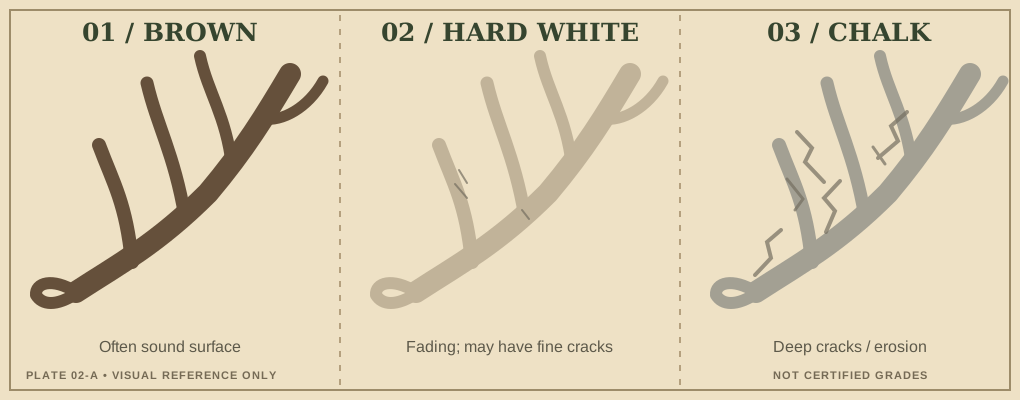
| Feature | Brown / Fresh | Hard White | Chalk / Heavily Weathered |
|---|---|---|---|
| Appearance | Often retains natural brown | Partly or fully bleached | Pale, gray, rough, eroded |
| Surface | Hard, sound; no deep weather damage | Hard; may show hairline cracking | Deep cracks; sometimes chalky or powdery |
| Damage | Allowance for chips and chewing varies | Minor flaws may be allowed | Material deterioration may be substantial |
| Common label | Often A / No. 1 | Often B | Sometimes C, sometimes D |
| Value trend | Often highest wholesale offers | Often lower than top grade | Often lower or declined |
This table is an editorial summary of practices described by Tex Creek, Rocky Mountain Antler Works, Hill Country, and Alaskan Antler Dog Chews, not a uniform industry rule.
02 / Brown Antlers — Fresh & Sound
Brown sheds usually retain some of their original exterior color and have firm, intact surfaces. Buyers commonly favor them for bulk material, craftwork, and display. But color by itself is not enough to award a high grade.
For example, Rocky Mountain Antler Works specifies no breaks, rodent chewing, or cracks for its Grade A brown antlers. Tex Creek Antler, by contrast, says its brown classification can include faded, broken, or chewed antlers so long as the material has no cracking. The difference is significant when preparing a lot for sale.
Look closely along the beam, near the burr, and around the bases of tines. Brown color does not prove that weathering cracks are absent.
03 / Hard White — Weathered, but Still Solid
Hard-white antlers have usually lost much of their original color through exposure. The beam can remain quite hard and structurally useful even though the outside looks pale. One side may be white while the side that rested against the ground still carries brown coloration.
The name is not perfectly literal. Tex Creek calls antlers with hairline cracking hard white even if the color is still brown. Hill Country Antler Buyers uses a different three-grade system: it places light or partially faded antlers without cracks in Grade 2 and cracked or chalky pieces in Grade 3.
Flip the shed over. Compare the sun-facing side with the ground-facing side, then inspect both sides for fine cracks. Color can change unevenly.
04 / Chalk — Deep Weathering & Deterioration
“Chalk” generally describes a heavily weathered antler with rough texture, pronounced cracks, gray or pale surfaces, and sometimes powdery or crumbling material. The label is often used when condition becomes a more important concern than color.
There is no universal chalk grade number. Rocky Mountain Antler Works labels chalk Grade C and says it does not buy that category. Alaskan Antler Dog Chews distinguishes cracked-white Grade C from more severely chalked Grade D. Tex Creek groups deep cracking, rough or gray deterioration, and treated antlers in its chalk category.
Chalk does not automatically mean a shed is worthless. Some art or craft buyers may use damaged antler, but other buyers will reject it. Deeply weathered material should not be presented as fresh, sound material.
05 / Why Shed Antlers Turn White
Once an antler is on the ground, exposure gradually affects its appearance and surface. Sunlight can fade color; rain, snow, ground moisture, and changes in exposure can alter the outside. Longer exposure may bring cracks and erosion. Rodents and other animals can also chew the material.
FIELD DIAGRAM 02-B. A conceptual progression, not an aging clock. Weathering rate depends on climate and exposure, and not all sheds pass through these stages in the same way.
You cannot reliably date an antler to a precise number of months or years by its color alone. A shed in a sunny, dry location may look very different from one lying in damp shade.
06 / Why Buyers Disagree on Grades
Different businesses buy antlers for different uses and may accept different degrees of cracking, broken points, bleaching, or chewing. Even when two buyers both use the words “Grade A,” their requirements may be quite different.
Tex Creek Antler
Cracks are central: its brown category can include fading, chewing, or broken points without cracks. Hairline cracks fit its hard-white category; deep cracks or altered surfaces fit chalk.
READ PUBLISHED GRADING RULES ↗Rocky Mountain Antler Works
Its Grade A brown requires fresh antlers without breaks, rodent chewing, or cracks. Grade B allows minor defects in hard antlers. The business says it will not buy Grade C chalk.
READ PUBLISHED BUYER LIST ↗Hill Country Antler Buyers
Grade 1 is fresh brown with no cracks; Grade 2 can be sun-faded or two-toned with no cracks; Grade 3 is cracked or chalky. It states it does not deduct for broken points.
READ SELLING PROCESS ↗Alaskan Antler Dog Chews
Uses A+, A, B, C and D designations: hard white is B, cracked white is C, and more severely chalked material is D. These categories are specific to that business's product grading.
READ THEIR GRADE DEFINITIONS ↗Bottom line: ask a buyer for their grading criteria, ideally with examples, before treating a category as an agreed price.
07 / What Does Grade Do to Price?
A published dealer price list can show how a buyer values condition—without representing what all antlers sell for nationwide.
Advertised buyer rates for elk antlers, not completed sale prices or market averages. Seller pays shipping; offers can change without notice. View original rate sheet ↗ (checked November 20, 2026).
For an illustrative 10-pound lot, those advertised rates would imply $140 at Grade A versus $100 at Grade B, before shipping or any additional conditions. That example is arithmetic, not a promise a dealer will accept your antlers at either grade.
Species, weight, matched sets, unusual form, and buyer demand also influence pricing. Use our full shed antler pricing guide and calculator to see more examples and how to distinguish dealer offers from asking prices.
08 / Grade Your Own Shed: Field Inspection
Use this checklist to make an accurate condition record before sending photos to a buyer. It will not award an automatic grade, since buyer standards differ.
Checks are stored only on this page during the current visit; no personal data is submitted. For seller photography tips, see our selling guide.
09 / Common Grading Mistakes
- Calling every white shed chalk. A light-colored antler can still have a hard, sound surface.
- Assuming all brown sheds are top grade. Cracks or damage may lower a dealer's assessment.
- Ignoring the underside. One side may remain brown while the other bleaches.
- Overlooking hairline cracking. Small cracks can matter more than color to some buyers.
- Assuming chewing always means rejection. Buyers have different tolerances.
- Hiding refinishing. Stained or painted antlers should be disclosed clearly.
- Guessing an exact age from appearance. Exposure conditions vary too widely.

10 / Can Weathered Antlers Still Be Used?
Yes, depending on their condition and the intended use. Some pale, hard antlers may be suitable for decoration or craftwork; collectors may prefer distinctive shapes regardless of grade. More deteriorated antlers may be of interest only to buyers who explicitly accept damaged material.
Safety caution: A damaged, cracked, or crumbly shed should not be recommended for pet chewing. Antler chews also carry risks for teeth and digestion regardless of grade, so the buyer should seek suitable veterinary guidance rather than relying on a grading label as a safety certification.
11 / Common Questions About Antler Grades
What are the three main grades of shed antlers?
Brown, hard white, and chalk are three commonly used condition categories. Some commercial buyers assign A, B and C to them, but others add more grades or use different criteria.
What does Grade A brown mean?
It usually describes sound, relatively fresh material, often brown in color. The allowable defects depend on the buyer's own written standard.
What is hard white antler?
A weathered antler that has faded or changed color while remaining hard. Depending on the buyer, some hairline cracks may also qualify.
Is hard white the same as chalk?
No. Hard white typically remains structurally sound; chalk generally refers to deeper weathering, cracking, and surface deterioration.
Can a brown antler be Grade B?
Yes. A brown-colored antler with hairline cracks or other disqualifying defects may fall into a lower category under a particular buyer's rules.
Are rodent-chewed antlers automatically lower grade?
Not everywhere. Tex Creek says chewing alone does not disqualify its brown classification if there are no cracks. Other buyers exclude chewing from Grade A.
Are chalk antlers worth anything?
Some buyers do accept damaged material, while others decline it entirely. Ask a specific buyer and distinguish an advertised offer from a completed sale.
Can I assign my own antler an official grade?
You can describe its condition and make a preliminary assessment, but there is no universal industry certification. A buyer determines their own acceptance and final grade.
12 / Research Method & References
This reference compares published business-specific grading systems rather than proposing an official industry standard. The condition table is a simplified educational summary. Any published dollar figures are labeled dealer quotations, not nationwide averages, not live offers, and not verified transactions. Source review date: November 20, 2026.
- Tex Creek Antler — Grading (cracks as its primary factor; brown, hard white, chalk).
- Rocky Mountain Antler Works — We Buy Antlers (grade criteria and advertised elk per-pound rates).
- Hill Country Antler Buyers — Selling Process (three grades; broken-point policy).
- Alaskan Antler Dog Chews — Antler Grading (A+ through D, including cracked white and chalk).
- U.S. Fish & Wildlife Service — Rodent-chewed antler photograph (NPS public-domain photo used as an illustrative condition example).
Commercial definitions may change without notice. Dealer gallery photographs have not been copied. Our condition plate is an original schematic, not a certified specimen set. If collecting or selling sheds, check the relevant wildlife and land-management rules. No specific antler appraisal is provided.
Buying antlers? Check out the Buyer’s Field Guide to inspect actual listings and compare total delivered costs.