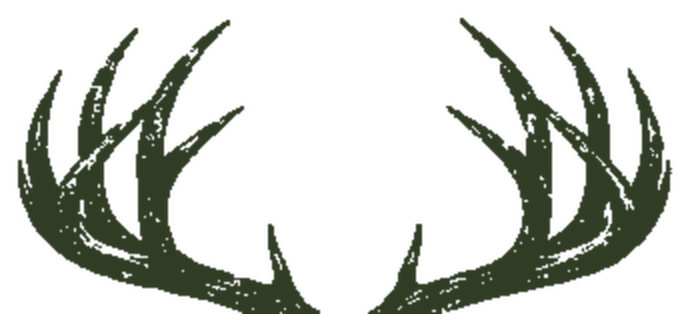
Begin with the beam and branching pattern. Typical elk antlers have a long sweeping beam with separated tines. Typical whitetail points rise from one main beam, while mature mule deer antlers commonly fork into smaller forks. Many mature moose antlers have broad flattened palms. Caribou antlers can be highly variable, sometimes with broad brow projections. Use several features together: no single tine, size measurement or photograph proves a species.
01 / Quick Antler Identification Chart
This chart describes common, typical antler shapes. Growth varies with age and individual animals; broken or non-typical antlers may not match a textbook example.
| Species | Look for | Don't rely on |
|---|---|---|
| Elk | Sweeping main beam; large, individually spaced tines | Size alone |
| Whitetail deer | Several tines rising from a curved, continuous beam | Point count alone |
| Mule deer | Y-shaped forks, frequently dividing again | Forking in young or atypical specimens |
| Moose | Broad, flat palms on many mature bulls | Expecting every young moose antler to have palms |
| Caribou | Variable, often asymmetrical branching; brow "shovels" on some | A single characteristic or assumed sex |
The photographs below depict documented real-world specimens. Differences in camera angle, specimen age and weathering mean they are not standardized to scale.
02 / Know the Parts of a Shed Antler
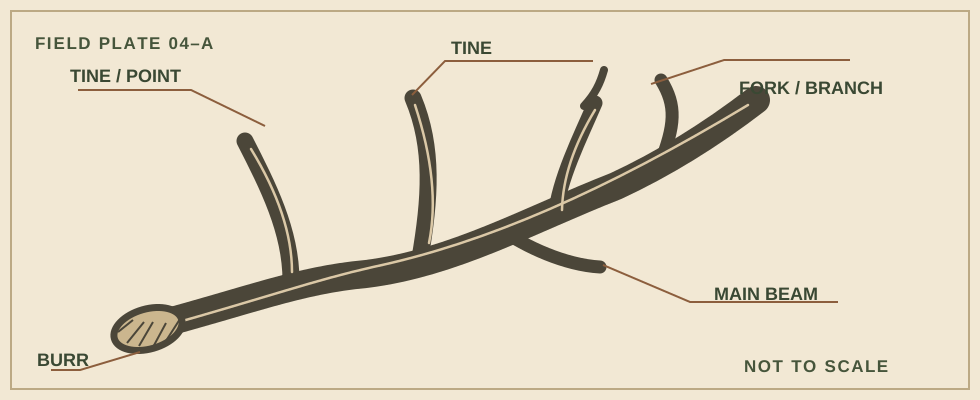
A few terms make identification much easier. The main beam is the primary antler structure, while a tine is a point projecting from it. A fork is where a branch splits. Palmation describes a broadened, flattened area, especially apparent in mature moose. Near the base is the textured burr (also called a coronet). The pedicle, by contrast, is the permanent bony attachment on the animal's skull, not a normal part of a shed.
03 / Five Species Reference Plates
Each species file pairs a documented photograph with practical recognition clues. Click the photo credit to see the original image and its reuse information.
ELK
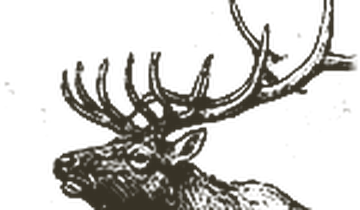

The American elk's antler often carries substantial, well-separated tines along a long beam that curves upward and backward. A complete, mature elk shed can be imposing, but smaller elk antlers and larger deer antlers can overlap in overall dimensions. Study the full curve and tine placement, not simply the weight or number of points.
CHECK FIRST: Is there a long main beam with prominent separated tines? See elk antler listings.
WHITETAIL DEER
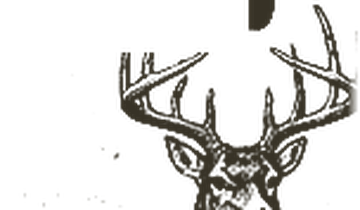

In a typical whitetail rack, individual upright points appear to arise from one uninterrupted, curving main beam. The photographed shed gives a clear example of the basic branching arrangement. Some bucks carry non-typical points or forked tines, so this pattern is a clue rather than a universal rule.
CHECK FIRST: Do the points arise separately from the beam rather than dividing into a series of forks? See whitetail listings.
MULE DEER

Mature mule deer antlers characteristically form forks, and larger forks may themselves divide into two points. This documented shed photographed by the Bureau of Land Management shows a branching fork, although it is not a complete mature rack. Young, broken or atypical specimens may be much harder to distinguish from whitetails.
CHECK FIRST: Does a branch split into a Y, rather than each tine independently leaving one beam? See mule deer listings.
MOOSE

The broad flattened portion of a mature moose antler is called a palm. The documented Denali shed shows palmation and several projecting points. However, younger moose may have narrower antlers with little palmation; identifying these from a single photo may be difficult.
CHECK FIRST: Is there a broad, flat blade-like area with points emerging from its edge? See moose listings.
CARIBOU

Caribou antlers are strikingly variable. Some have flattened brow projections known informally as shovels, while others are comparatively slender or less palmated. The verified Arctic Refuge shed shown here is a small section of a caribou antler; it should not be treated as an example of a complete mature rack. Both males and females of this species can grow antlers.
CHECK FIRST: Consider the combination of branching, brow projections and provenance; a fragment may require specialist identification. See caribou listings.
04 / Whitetail vs. Mule Deer: Branching Pattern
This is one of the most useful comparisons for hunters in the West. Typical whitetail antlers grow individual points off a main beam. Mature mule deer antlers often split into paired forks. However, forked whitetail tines and non-forking young mule deer antlers do occur—never decide from one point.
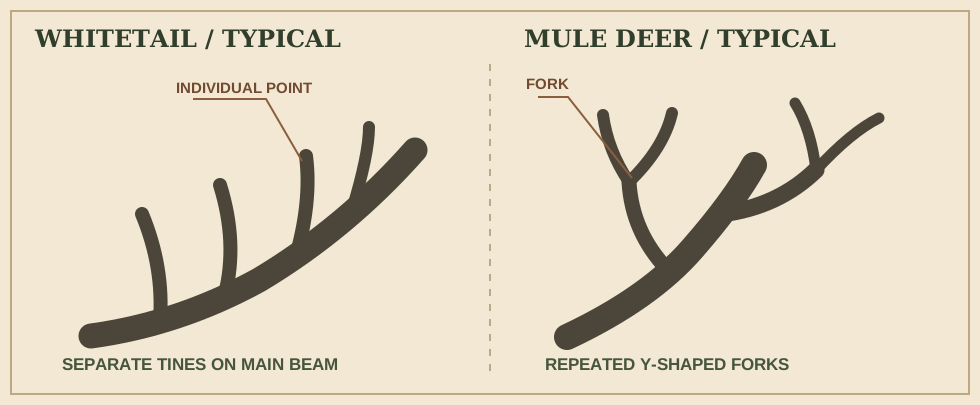
The two patterns are useful field clues, not conclusive species tests. Where available, consider the documented animal, location and additional characteristics, or consult a qualified wildlife professional.
05 / Natural Shed vs. Saw-Cut or Broken Antler
Look closely at the base. A naturally shed antler separates from its pedicle at a biological separation surface, usually leaving a textured burr and a rough separation face. A saw-cut antler may show a flattened cut surface and parallel tool marks. A broken tine or beam can expose irregular bone away from the normal base. Weathering and subsequent handling can blur these distinctions.
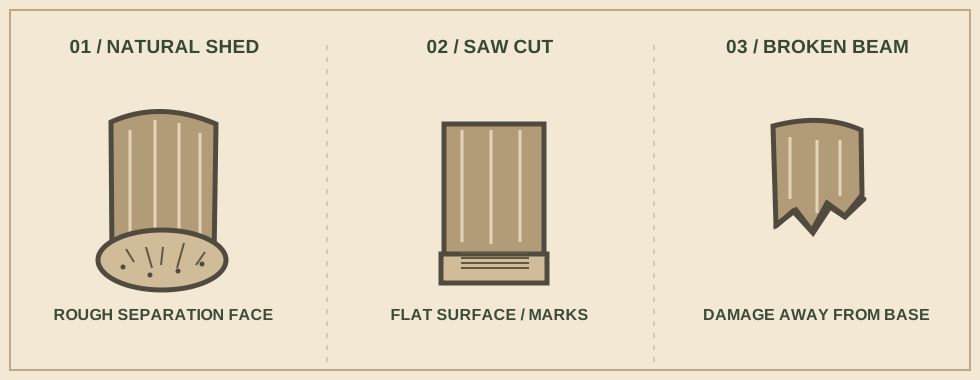
Remember: A naturally shed antler normally does not include the skull's pedicle. A skull plate still attached to antlers indicates that the antlers were not naturally dropped as separate sheds.
06 / Unusual Antlers & Misidentification
Antlers sometimes show drop tines, extra points, asymmetry, unusual bends or damaged tips. Age, injury and other factors can alter their appearance, but a photograph alone is not enough to diagnose the cause. Rodent chewing or heavy weathering can remove features that were once visible.
YOUNG ANIMALS
Young moose may lack wide palms. Young mule deer may show limited forking. Don't force a juvenile specimen into a mature-antler diagram.
BROKEN OR ATYPICAL
Missing tines, extra branches and non-typical growth can change the profile. Inspect every remaining branch and the base.
07 / Five-Step Shed Identification Checklist
Use this simple field card before assigning a species to a shed or creating a marketplace listing. You can check off the steps as you go.
08 / Photograph a Shed for Identification
Good photographs make expert identification and accurate marketplace listings easier. Place the antler on a neutral surface and photograph it in soft natural light. Include a full-length side profile, a view from the opposite side, a close-up of the branching, and a clear close-up of the burr/base. Put a ruler alongside the beam for scale rather than using an unknown-size object.
If you plan to sell a shed, don't crop out broken ends or conceal chewing and weathering. Our online selling guide explains how clear listings help buyers.
09 / Common Identification Questions
How can I tell elk and deer antlers apart?
Elk often have larger, longer sweeping beams with substantial separated tines. Size by itself is not proof. Compare beam shape and the overall branching pattern, especially with incomplete specimens.
What is the main difference between mule deer and whitetail antlers?
Many typical whitetails have individual tines rising from one beam; mature mule deer commonly develop forked branches. Both patterns have exceptions, particularly in younger and non-typical animals.
Do all moose antlers have broad palms?
No. Large flat palms are common on mature bulls, but younger bulls may have narrow antlers with little palmation.
What does the bottom of a naturally shed antler look like?
The burr surrounds an irregular biological separation surface. A saw-cut base may look flatter and show tool marks. Very weathered or damaged antlers can be harder to judge.
Can an antler have extra or unusual points?
Yes. Atypical growth can include extra tines, drop tines and irregular branching. These differences don't automatically mean the antler came from another species.
Can I identify an antler from size alone?
No. Age, individual variation, and breakage create overlap. Combine size with branching, beam shape, base features and reliable location information.
Can female deer grow antlers?
Female caribou commonly grow antlers, although not all do. Antlers in other deer species are predominantly found on males, with rare exceptions.
10 / Specimen Photo Credits & Licenses
The five photographs are sourced from individually documented records on Wikimedia Commons. They are real photographs; the anatomy and branching plates are original educational illustrations. Photographs are shown as reference examples, not standardized specimen comparisons. By default, Wikimedia hosts these photographs; if a photo cannot load, the site's existing species engraving appears instead. Optional locally hosted copies can be installed for better reliability.
| Photo | Credit and license | Original file |
|---|---|---|
| ELK | Kari Cieszkiewicz / USFWS Public domain | Wikimedia record ↗ |
| WHITETAIL DEER | Tom Koerner / USFWS Public domain; Commons also lists CC BY 2.0 | Wikimedia record ↗ |
| MULE DEER | Bob Wick / BLM Nevada CC BY 2.0 license ↗ | Wikimedia record ↗ |
| MOOSE | Paxson Woelber CC BY-SA 3.0 license ↗ | Wikimedia record ↗ |
| CARIBOU | Lisa Hupp / USFWS Public domain | Wikimedia record ↗ |
Credits and license details were checked November 20, 2026. The page doesn't claim that the wildlife agencies endorse AntlerSheds. For Creative Commons photos, this page provides author credit, file link, and license link; source photographs have not been visually altered; optional local copies are resized and WebP-converted for delivery.
Wildlife References & Further Reading
- Idaho Fish and Game — Mule deer versus whitetail deer
- Boone and Crockett Club — Field judging American elk
- Boone and Crockett Club — Field judging mule deer and blacktails
- U.S. Fish and Wildlife Service — Eight points about antlers
- Alaska Department of Fish and Game — Caribou identification
Editorial note: This article provides general visual identification guidance. Species determination for legal, protected-wildlife, or high-value transactions may require a qualified assessment and verification of provenance.