To measure a shed antler, identify the species and side, record the curved main-beam length, measure each tine from its proper baseline, measure the beam's circumference at defined places, count the points, and weigh the shed. For a marketplace listing, record overall dimensions and condition as well. A measuring record is useful without being an official trophy score: scoring systems use species-specific rules and may require the intact skull or a certified measurer.
01 / Tools & Setup
Start with a clean, stable surface and a bright light. Place the antler so you can see the outer face of the main beam and the bases of its points. Photograph it before taking measurements, particularly if it has an unusual tine or damage.
For B&C-style scoring, a non-stretching flexible cable is used for certain curved lengths, while circumference readings require the proper flexible tape. Official score sheets generally record measurements in eighths of an inch. See Boone and Crockett's equipment policy and the species-specific sheets for approved methods.
02 / Measure the Main Beam
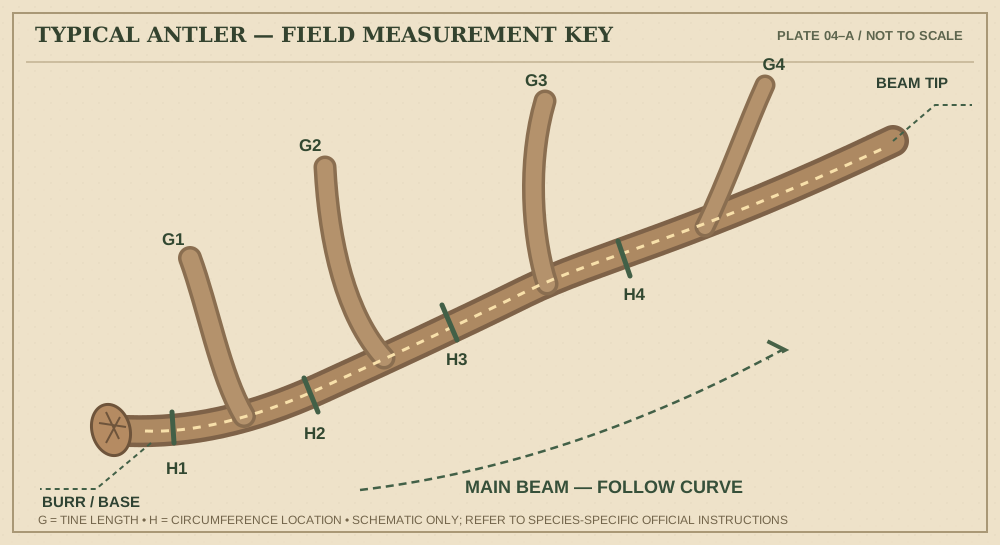
The main beam is the long central antler structure. On a typical elk or deer antler, trace its prescribed outside curve from the base near the burr toward its terminal tip with a flexible cable. Keep the cable following the beam's natural curve; then lay the cable against a ruler or measuring tape. A direct straight-line measurement from the base to the tip is not the same as main-beam length.
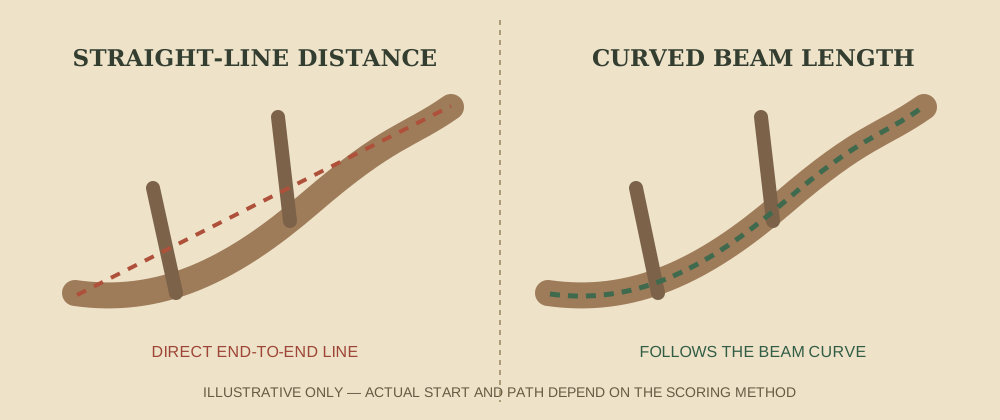
For sellers, it may help to record both the scoring-method main-beam length and the antler's overall physical length if buyers request them. Label the two separately instead of treating them as interchangeable measurements.
03 / Measure the Tines (G Measurements)
Tines are projections growing off the main beam. In common Boone and Crockett deer and elk notation, normal point lengths are often identified as G1, G2, G3 and so on. Before measuring a tine, identify where it joins the beam and establish its baseline; using masking tape to mark the baseline avoids writing directly on the antler. Measure from that prescribed baseline along the tine's curve to its tip.
In Boone and Crockett's whitetail rules, a measurable point must project at least one inch and be longer than its width. The main-beam tip counts in the total point count, but its length is not entered a second time as a G measurement. Abnormal points may need a different classification. B&C's whitetail scoring explanation gives the method and the exceptions.
Don't measure a tine from the bottom edge next to the burr simply because that produces a longer number. Tine baselines—and unusual points—are defined by the scoring rules, not by the longest route you can find.
04 / Measure Circumference (H Measurements)
Circumference describes how thick the beam is around a particular location; trophy measurers often refer to this as mass. Wrap a flexible tape around the antler without leaving gaps or compressing the surface. For standard Boone and Crockett deer and elk charts, there are four circumference measurements per side at defined beam locations, generally at the narrowest places between normal points. If a normal point is missing, the chart tells you where to place the tape instead.
Don't assume every antler species uses the same H locations. A palmated moose antler, for example, follows a different species-specific procedure. Use the official species-specific chart when precision matters.
05 / Count Points Without Double-Counting
In common hunting descriptions, a deer with four countable points on each side may be called an 8-point buck (total count) or a 4×4 (count by side). Elk racks are commonly described by points per side, such as 6×6. Include the tip of each main beam in the point count, but don't enter it again as a separate tine length. Regional terminology and legal hunting definitions can differ from trophy-scoring definitions. USFWS explains common point-count conventions.
| Measurement | What to record | Common mix-up |
|---|---|---|
| Main beam | Curved beam length, inches | Using straight-line length instead |
| Tines | Each qualifying point length | Starting below its correct baseline |
| Circumference | Beam girth at prescribed locations | Calling weight a circumference measure |
| Point count | Number of points, by side | Not counting the beam tip |
| Weight | Pounds or ounces of the loose shed | Treating weight as a trophy-score component |
06 / Do Different Species Use Different Rules?
Yes. Antler form changes what can be measured and how a score is calculated. The following is a recognition guide, not a substitute for the applicable score sheet.
| Species | Key measuring consideration |
|---|---|
| Whitetail deer | Main beam; normal and abnormal points; four circumference positions; spread for intact trophies. |
| Mule deer | Branching often forks: the correct point designations differ from whitetail. |
| Elk | Long beams and tines; take care with lower tine baselines and the curved beam. |
| Moose | Palm width, palm length, and points require a separate method—not the standard deer diagram. |
| Caribou | Complex branching and palmated portions require specialized measurements. |
The Boone and Crockett chart directory contains separate measuring instructions for elk, mule deer, whitetail deer, moose and caribou. For elk field practice, the Rocky Mountain Elk Foundation's measuring guide offers helpful examples.
07 / Can You Officially Score a Shed Antler?
A shed can be scored, but not in every records program. The Boone and Crockett Club does not accept naturally shed antlers for entry in its big-game records or awards program, even when two loose sheds appear to form a matched pair. The original spread and their original relation to the skull cannot be verified. You may still take physical measurements or make an expressly unofficial comparison. Read the B&C eligibility policy.
The North American Shed Hunters Club (NASHC), by contrast, operates a record program specifically for naturally shed antlers, including single sheds and matched sets. Its current rules and qualified-measurer requirements—not Boone and Crockett's entry policy—govern entries to that program. See NASHC and its shed score sheets.
Eligible intact trophies require the correct score sheet, drying period and official procedures. Informal home estimates are not certified entries.
A dedicated scoring and records program for singles and matched sets, subject to current NASHC instructions and qualified measurement.
In eligible Boone and Crockett scoring, gross and net/final are different. Gross includes measurable growth before symmetry deductions; final/net scoring applies the category's deduction rules. Both are scoring terms, not dollar values. B&C's official scoring also has a required drying period for eligible trophies. See its records FAQ.
08 / Example: Record a Whitetail Shed
Here's what a practical sales-measurement record might look like. These numbers are illustrative, not measured from a verified specimen or an official score sheet.
Single whitetail shed
Brown • 5 countable points • intact burr
- Main beam
- 23½ in
- G1 / brow tine
- 4 in
- G2
- 9 in
- G3
- 8 in
- G4
- 5 in
- Base circumference
- 4½ in
A comparable elk seller's record would include beam and tine measurements, point count, antler weight and any damage. If you have both sides, measure them independently and record whether they are a confirmed or presumed matched pair. Similar dimensions alone don't establish that two sheds came from the same animal.
09 / Field Measurement Worksheet
Use this worksheet to record a shed at home. It is designed for accurate listing descriptions—not a substitute for the official score sheets of B&C, NASHC, or another organization. Entries stay in this browser session; nothing is submitted to AntlerSheds.
SHED MEASUREMENT LOG
Physical measurements only • Inches unless noted
10 / Matched Sheds, Mistakes & Selling
When you find two sheds that appear to be from one animal, measure each separately, noting the side, beam length, point pattern, mass and base details. Compare the bases and color, and photograph them together as well as individually. Unless their shared origin is known, call them a possible matched set rather than stating the match as a fact.
- Confirm the species as well as you can.
- Record each shed's side and individual measurements.
- Follow the beam curve, not the straight-line distance.
- Check tine baselines and don't double-count the beam tip.
- Keep circumference, overall dimensions and weight separate.
- Photograph the burr, damage, a scale reference and both sides.
- Label any score unofficial unless verified under the relevant rules.
A larger scoring figure does not guarantee a higher sale price. Species, grade, display appeal, weight, and actual buyer interest still matter. For the commercial side, read How Much Are Shed Antlers Worth? and Antler Grades Explained.
11 / Frequently Asked Questions
Can I score a single shed antler?
Yes, you can record measurements and use the North American Shed Hunters Club's shed-specific scoring process. A single shed is not eligible for Boone and Crockett's big-game record book.
Does the tip of the main beam count as a point?
In common deer and elk point counting, yes. For B&C-style measurement, the beam tip is already included in the main-beam length and should not also be recorded as a separate G tine length.
What are G and H measurements?
On common deer and elk trophy charts, G values describe lengths of normal tines and H values describe circumference at defined locations. The exact positions vary with the species and score chart.
How do I measure a broken tine?
Record the observed remaining length and disclose that the point is broken. Do not guess an unbroken original length or claim an official point measurement without checking the relevant scoring organization's rule.
Can I estimate the score of a matched pair of sheds?
You may make a clearly labeled estimate for comparison, but you cannot establish a verified original inside spread from loose antlers. For formal shed record entries, consult NASHC's own matched-set requirements.
Does higher antler score mean higher sale price?
Not automatically. Condition, species, weight, size, matched-set provenance, and buyer demand can all influence price. Use documented market comparisons rather than treating score as a price calculator.
Sources & Measuring References
- Boone and Crockett Club — species-specific official score chart directory (instructions; charts are copyrighted and intended for personal use).
- Boone and Crockett Club — whitetail measuring tips (baseline, point, and H measurement rules).
- Boone and Crockett Club — records policies (shed eligibility, measuring tools and score terminology).
- North American Shed Hunters Club — shed record program and score sheets.
- Rocky Mountain Elk Foundation — How to Measure Your Elk.
- U.S. Fish and Wildlife Service — Eight Points About Antlers (point-count conventions).
Editorial note: This is an educational measurement and listing guide, not an official scoring manual. Original technical diagrams are simplified and not drawn to scale. For records, competition, or precise scores, use the correct organization's current rules and an authorized measurer. Sources reviewed November 20, 2026.